Medical device manufacturers collect vast amounts of post-market surveillance (PMS) data, yet important product risks are still frequently recognized only after complaint trends become statistically significant or corrective actions become unavoidable.1-5 The challenge is rarely a lack of information. More often, organizations fail to connect subtle observations across multiple sources of evidence before meaningful risk emerges. This article explores why emerging product risks are often missed and presents an engineering-centered approach to interpreting weak signals before they evolve into systemic quality issues.
Risk Rarely Appears All at Once
Major product issues are often described as unexpected. In reality, most are preceded by numerous observations that, when viewed individually, appear insignificant. A physician notices a subtle change in device handling during a complex procedure. A returned product exhibits a wear pattern that remains within specification but differs slightly from previous evaluations. A manufacturing engineer observes a gradual shift in process capability that remains comfortably inside validated limits. A supplier reports minor variation in a raw material characteristic that does not exceed incoming acceptance criteria. A service engineer documents an isolated field observation that appears unrelated to previous complaints. Each observation, considered independently, is explainable. None necessarily warrants escalation.
Together, these observations may represent the first indication that product behavior is changing. The problem is seldom insufficient data. Instead, early evidence is fragmented across different functions and rarely interpreted together. They miss risk because the earliest indicators seldom resemble traditional complaint trends. Instead, they appear as isolated technical observations distributed across different functions, collected by different teams, and interpreted within different organizational contexts.
By the time these observations accumulate into statistically significant complaint trends, the underlying mechanism may already be well established. The opportunity, therefore, is not simply detecting more complaints. It is recognizing engineering mechanisms while evidence is still fragmented.
Why Conventional Trending Has Limits
Complaint trending remains one of the most valuable components of every post-market surveillance program and is a fundamental expectation of modern quality management systems and regulatory frameworks.1-6
Trend analysis supports regulatory reporting, identifies changes in field performance, and helps organizations prioritize investigative resources.1,5,6 Statistical methods provide an objective way to determine whether observed changes are likely to represent meaningful deviations from historical performance.¹
However, statistics alone cannot explain engineering behavior. Trend analysis is inherently retrospective. It identifies changes that have already become measurable. Engineering investigations often require a different perspective. The earliest evidence of an emerging product issue may consist of only a handful of technically related remarks that never exceed statistical thresholds. Waiting for complaint frequency alone to trigger investigation may therefore delay recognition of the underlying mechanism.
Engineering teams must be prepared to ask a different question: Do these observations share a common technical explanation, even if they do not yet constitute a measurable trend?
Answering that question requires engineering judgment rather than statistical confidence alone. It also requires integrating information that traditionally resides in separate organizational functions. Returned product analysis, supplier quality, manufacturing performance, verification data, service information, clinical feedback, and risk management each provide different perspectives on product behavior. Individually, each dataset is incomplete. Collectively, they often reveal relationships that would otherwise remain hidden. This is where post-market engineering extends beyond conventional complaint management.
It shifts the focus from recognizing trends to understanding mechanisms.
From Weak Signals to Engineering Mechanisms
One of the most common misconceptions in post-market surveillance is that product risk emerges as a sudden event. Engineering experience suggests otherwise. Most significant quality issues evolve gradually as small technical performances accumulate over time. The challenge is that these observations rarely originate from a single source or present themselves in a way that immediately suggests a common cause.
A complaint may describe a device performance issue. A returned product analysis may identify minor wear that remains within specification. A manufacturing trend may show subtle process drift that does not affect product release criteria. A supplier investigation may reveal small changes in material characteristics that remain compliant with agreed specifications. Individually, each observation appears explainable. Together, they may represent different manifestations of the same engineering mechanism.
The distinction between an event and a mechanism is fundamental.
An event answers the question: “What happened?”
A mechanism answers the question: “Why is this happening?”
Complaint investigations are often structured around explaining individual events. Engineering organizations, however, create greater value when they identify mechanisms that explain multiple events simultaneously.
For example, five complaints may describe slightly different symptoms observed in different clinical settings. Viewed independently, each complaint may appear unique. Viewed collectively, those same observations may indicate a common interaction among material properties, manufacturing variability, environmental exposure, and clinical use conditions.
Understanding that interaction—not simply documenting the individual complaints—is what enables meaningful engineering improvement. Engineering interpretation depends on integrating evidence across disciplines while remaining willing to challenge assumptions established during product development. Rather than asking whether each investigation reached an appropriate conclusion, engineering teams should ask a different question:
What assumptions about product performance are these observations challenging?
That question transforms post-market surveillance from an investigative activity into an engineering learning process.
Recognizing Signals Before They Become Trends
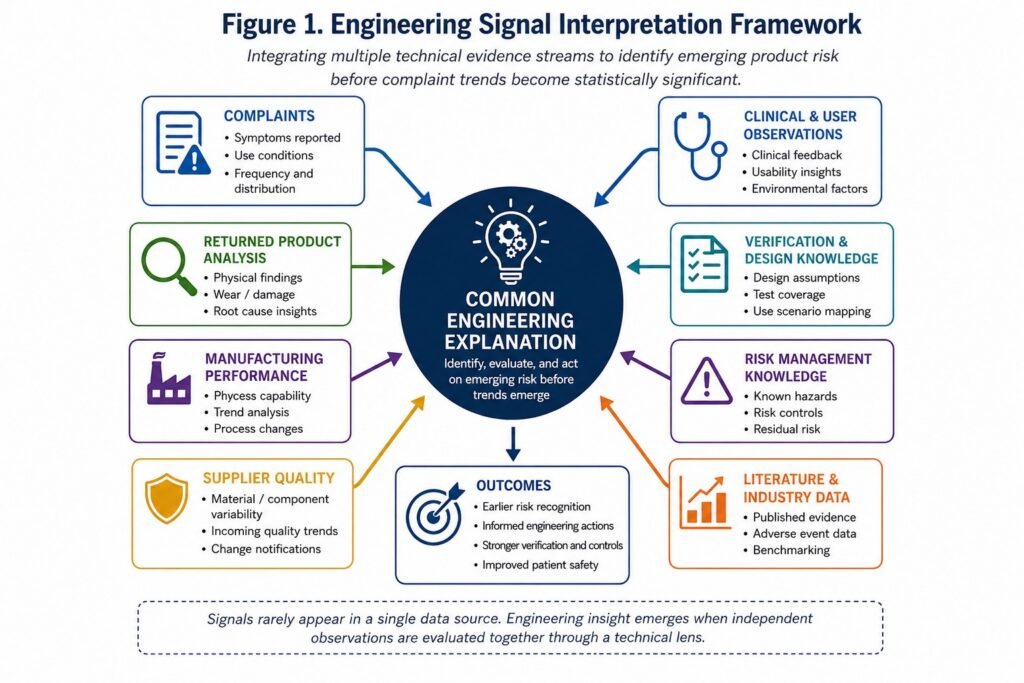
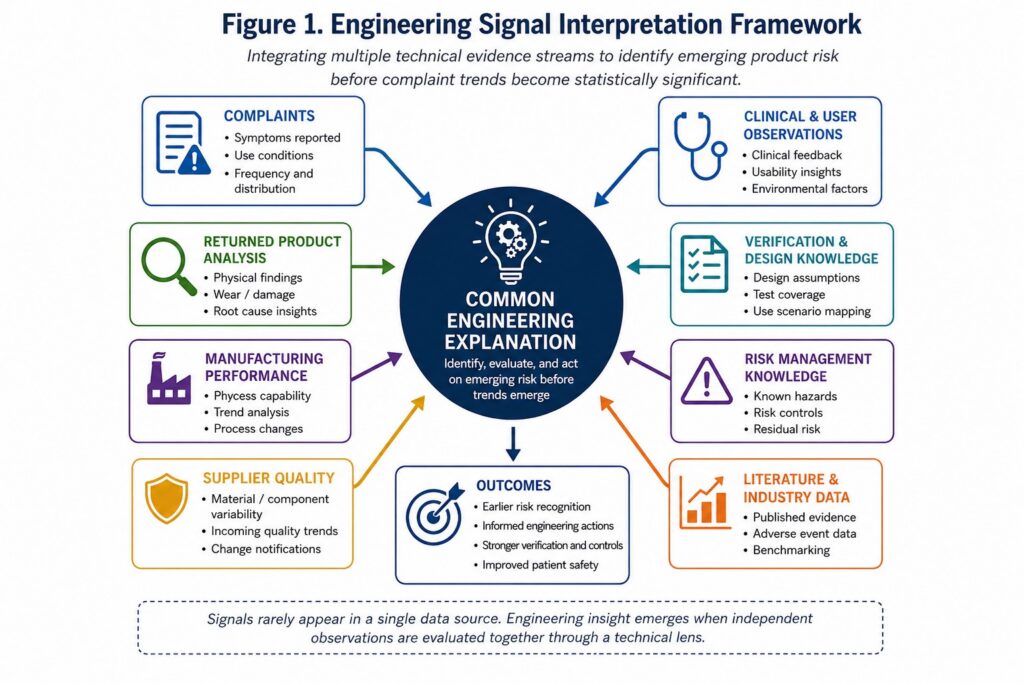
The ability to recognize emerging product risk depends less on individual expertise than on how effectively technical information moves across the organization. Instead, they establish a disciplined process for integrating technical evidence from across the product lifecycle. No single data source explains emerging product risk. Returned product evaluations reveal physical evidence. Manufacturing records show process stability. Supplier quality identifies material variation. Verification documentation defines the assumptions tested during development, while risk management establishes the hazards already anticipated. Viewed independently, each source answers a different question. Viewed together, they provide a more complete understanding of product behavior.⁴
When these sources are interpreted together, engineering teams gain a broader understanding of product behavior than complaint data alone can provide.
Figure 1 illustrates this concept by showing how independent technical evidence converges toward identification of a common underlying pattern. Rather than relying exclusively on complaint frequency, organizations evaluate multiple evidence streams to determine whether they collectively challenge existing engineering assumptions.
Importantly, this approach does not replace statistical trending or established quality system processes. Engineering interpretation complements statistical trending by providing technical context before statistical evidence alone would justify escalation.1,5-7
Instead, engineering interpretation complements those activities by providing technical context before statistical evidence alone would justify escalation. The objective is not to identify more signals. It is to identify the right signals sooner.
Teams that consistently integrate these perspectives identify important product changes earlier. This perspective represents one of the defining characteristics of mature post-market engineering organizations.
Leadership Implications: Creating an Organization That Recognizes Risk Earlier
Recognizing emerging product risk is not solely a technical challenge. It is an organizational capability. Many medical device companies possess highly capable engineers, sophisticated analytical tools, and mature quality systems. Yet important product behavior may still remain undiscovered because technical information is reviewed within functional boundaries rather than interpreted collectively.
Engineering investigates returned products. Quality reviews complaints. Manufacturing monitors process capability. Supplier quality evaluates incoming materials. Clinical teams assess field experience. Risk management maintains the product risk file. Each function performs its responsibilities effectively. The challenge is that emerging patterns or failure modes rarely develop within the boundaries of a single function. They emerge at the intersection of multiple evidence streams.
Organizations that consistently recognize risk earlier create structured opportunities for these perspectives to converge. Cross-functional technical reviews become more than status meetings—they become forums for engineering hypothesis generation. Investigators are encouraged to challenge existing assumptions, explore alternative explanations, and determine whether apparently unrelated observations may share a common mechanism.
This shift changes the purpose of post-market review. Instead of asking whether each investigation can be closed, leadership teams begin asking whether the organization’s understanding of product performance has improved. That distinction changes how success is measured.
Traditional performance indicators such as complaint aging, investigation cycle time, CAPA closure, and regulatory compliance remain essential because they demonstrate operational discipline. However, they do not indicate whether engineering knowledge is increasing. Engineering leaders should therefore introduce complementary measures that evaluate organizational learning.
Examples include:
- Time from identification of a meaningful engineering signal to cross-functional engineering review.
- Number of verification activities strengthened because of post-market findings.
- Engineering improvements initiated before complaint trends reached statistical significance.
- Repeat occurrence of similar issues following engineering action.
- Design or risk management assumptions refined using real-world product performance.
Table 1 compares traditional operational metrics with engineering learning metrics that better reflect an organization’s ability to recognize and respond to emerging product risk.

These measures encourage engineering teams to view post-market surveillance not as a regulatory obligation, but as a continuous source of product knowledge.
Conclusion
Medical device organizations have never possessed more information about product performance than they do today. The next competitive advantage will not come from collecting additional data. It will come from recognizing engineering meaning within the data that already exist. Major product issues seldom appear without warning. More often, they emerge gradually through a series of weak technical findings that, individually, appear insignificant but collectively reveal an underlying cause for product behavior. Companies that recognize these patterns early gain more than regulatory compliance. They strengthen verification strategies, refine design assumptions, improve manufacturing controls, and reduce future product risk before isolated observations become widespread quality issues. Statistical trending remains essential, but engineering interpretation explains why performance changes long before statistics alone tell the full story.1-6
Engineering interpretation extends its value by asking a different question.
Not simply: “Has product performance changed?”
But rather: “What engineering mechanism is our product trying to reveal?”
The organizations that answer that question consistently will not merely respond to product issues more effectively. The companies that learn fastest from real-world performance will build the next generation of safer, more reliable medical devices returned.
References
- FDA Postmarket Surveillance Under Section 522
- FDA Total Product Life Cycle Advisory Program
- ISO 13485:2016
- ISO 14971:2019
- EU MDR 2017/745 Article 83
- MDCG Guidance on Post-Market Surveillance and PSUR
- IMDRF Post-Market Surveillance Guidance
- FDA Human Factors Guidance
The post Why Organizations Miss Emerging Product Risk: Understanding the engineering mechanisms that remain hidden long before complaint trends become visible appeared first on MedTech Intelligence.